Lung Cancer Answers is a website devoted to life issues for lung cancer patients and their families and is sponsored by Brad Cooper* of Cooper, Hart, Leggiero & Whitehead, PLLC. Cooper, Hart, Leggiero & Whitehead is located in The Woodlands, Texas (Greater Houston Area), handles cases nationwide with co-counsel in state of filing, and can be reached toll-free at 1-800-998-9729 for more information on lung cancer. Brad Cooper is not a medical doctor. The information on these pages is for the education of lung cancer patients and their families regarding potential medical and legal options. Patients are advised to consult with a medical doctor.
* Licensed by the Supreme Courts of Texas.
Both small cell lung cancer and non-small cell lung cancer are named for the kinds of cells found in the cancer and how the cells appear when viewed under a microscope. The cancer cells of each type grow and spread in different ways.

Non-small cell lung cancer (NSCLC) is the most common type of lung cancer, accounting for 84% of all lung cancer diagnoses. Common risk factors for NSCLC include active smoking, passive smoking (secondhand smoke), asbestos, and radon exposure. Not everyone will experience symptoms. If they do, however, they are similar to those of small cell lung cancer.
NSCLC gets its name from the way that the cancer cells look under a microscope. There are three main types of non-small cell lung cancer.
- Adenocarcinoma
- Squamous Cell Carcinoma
- Large Cell Carcinoma
Adenocarcinoma
Adenocarcinoma is the single most common type of lung cancer, accounting for about 40% of NSCLC cases. Lung adenocarcinoma starts in glandular cells, which secrete substances such as mucus.
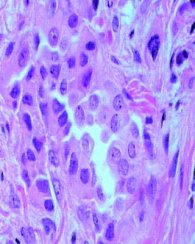
Adenocarcinoma of the lung can be divided into four categories, which are based on how the cells look and are arranged under the microscope:
- Acinar (of or relating to a gland)
- Bronchoalveolar (come from cells higher up in the lungs)
- Mucus-secreting
- Papillary (resemble nipples or pimples)
This type of NSCLC is usually located more along the lungs’ outer edges and tends to grow more slowly than other lung cancers. Because of this, it is sometimes possible to guide a needle from the outside of the body in order to perform a biopsy.
Squamous Cell Carcinoma
Squamous cell carcinoma is the second most common type of lung cancer, accounting for roughly 30% of non-small cell lung cancer cases. Squamous cells are “scale-shaped” and occur along the trachea and bronchi. Under a microscope, squamous cell carcinoma is characterized by “keratin pearls” that are recognized by a pathologist.
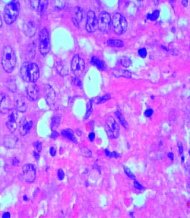
Because squamous cells are exposed to the environment during breathing, they are relatively hearty cells. In some ways squamous cells are like skin cells: they can tolerate contact with air (for the most part) and they tend to slough off (exfoliate) like skin cells. However, they are not immune to cigarette smoke and other toxic substances. In fact, the risk of developing this type of lung cancer increases in direct proportion to the number of cigarettes smoked over time.
In contrast to lung adenocarcinoma, squamous cell carcinoma is usually found near the center of the lungs. This means that it is unlikely that a biopsy can be performed outside the body. Instead, a bronchoscope (a thin tube with a light, a camera, and small surgical instruments in the tip) can be advanced down the throat, into the trachea, and to the bronchus that contains the tumor.
Unlike other types of NSCLC, symptoms are often experienced earlier due to the location of squamous cell carcinoma. This is actually beneficial as a diagnosis can be made sooner than other lung cancers overall.
Large Cell Carcinoma
Large cell carcinoma is the rarest subtype of non-small cell lung cancer, distinguished from small cell lung cancer cells by the larger size of its cells. It accounts for about 15% of lung cancer cases.
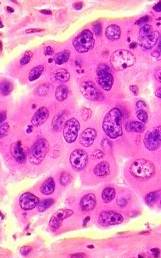
Large cell lung cancers do not necessarily occur near the chest wall, though they often occur near the lung’s edge rather than near a bronchus (in the center). Therefore, a needle biopsy may or may not be possible, depending on location. If a needle biopsy is not possible, a tissue sample may need to be gathered using a surgical approach. When this is required, the entire tumor may be removed both for purposes of diagnosis and treatment.
Large cell carcinoma is identified as being different from the other types of lung cancers histologically. These cells do not have the necessary equipment to secrete substances like adenocarcinoma. Nor do they look like scales with keratin pearls, which would indicate squamous cell carcinoma. Large cell carcinoma appears rather strange under a microscope in that it looks like sheets of abnormal cells with an area of dead cells in the middle.
Small cell lung cancer (SCLC) is responsible for about 13% of lung cancer cases. The most common risk factor for developing this type of lung cancer is smoking tobacco.
There are two main types of small cell lung cancers, which include many different types of cells that grow and spread in different ways. The types of small cell lung cancer are named for the kinds of cells found in the cancer and how the cells look when viewed under a microscope:
- Small cell carcinoma (also known as oat cell cancer)
- Combined small cell carcinoma
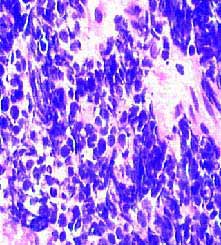
Perhaps the most important reason to distinguish small-cell lung cancer (SCLC) from other types is that it behaves differently from other lung cancers. While most other types of lung cancer are slow-growing, SCLC grows very rapidly and is very aggressive, swiftly spreading to distant areas in the body (metastasis).
Despite its aggressiveness, small-cell lung cancer responds very well to chemotherapy and radiation treatments. In fact, surgery is rarely performed for small-cell lung cancer. This does not necessarily mean that small-cell lung cancer has a good prognosis, especially since the disease is often widespread at the time of diagnosis. However, it does mean that surgery is almost always unnecessary in SCLC.
Small-cell lung cancers are somewhat unique in where they form in the lung. They usually grow on the bronchus— a large airway that leads from the trachea (windpipe) to a lung— but mostly stay on the lung side of the bronchus rather than growing in the airway.
This peribronchial location has advantages and disadvantages for the patient. Since the small-cell lung cancer is reasonably close to the bronchus, a biopsy can be taken using a bronchoscope. This means that often surgery can be avoided. However, since the tumor may not invade the airway, the primary tumor does not cause symptoms until it has spread. Lack of obvious symptoms delays diagnosis and treatment.
When symptoms are experienced, they may include:
- Fatigue
- Lingering cough
- Weakness
- Shortness of breath
- Chest discomfort or pain
- Loss of appetite
- Unexplained weight loss
- Coughing up phlegm or mucus
- Coughing up blood
- Swelling of the face or neck
Additionally, these lung cancers are notorious for causing paraneoplastic syndromes. A paraneoplastic syndrome is a collection of symptoms caused by the immune system inappropriately reacting to cancer. Alternatively, some paraneoplastic syndromes are caused by molecules that are released by the cancer itself. Small-cell lung cancer can cause several different paraneoplastic syndromes leading to hormonal disturbances or neurological deficits.
If you, or someone you know, has lung cancer and you would like to know if they qualify for additional compensation, please call 1-800-998-9729 for a FREE consultation.

©2026 Cooper, Hart, Leggiero & Whitehead, PLLC. All rights reserved.